Thermador’s cooking line covers gas ranges and rangetops with the star-shaped burner, induction and electric cooktops, and combinations of the two. They share a control philosophy and very little else, so the diagnosis splits early.
Gas: clicking, yellow flame, and the electrode
The most common gas call is a burner that clicks without lighting. The second most common is every burner clicking when one knob is turned. Owners usually read the second as a serious control fault; it is generally the same fault as the first.
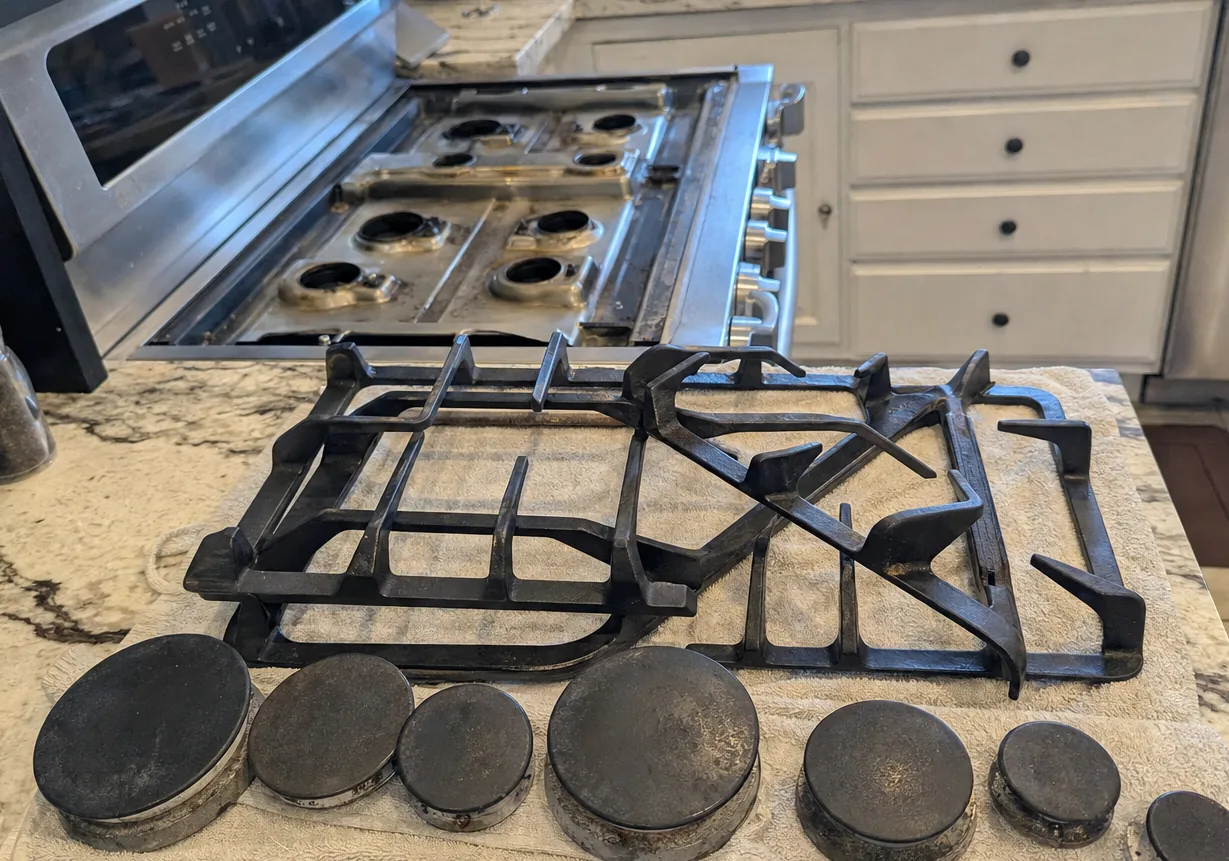
The spark module fires all electrodes on the same circuit and stops when it sees a flame established at the burner that was called for. If the electrode at that burner is wet, greasy, cracked at the ceramic, or sitting slightly out of position, no flame is sensed, so the module keeps firing everything. Clean and dry the electrode, seat the burner cap square, and the chorus stops.
A yellow, lazy flame is a different question and worth taking seriously. Burner ports partially blocked by boil-over will distort the flame pattern, and so will a burner cap that has been put back on the wrong burner during cleaning — the caps are not interchangeable across sizes. If the ports are clear and the cap is right, the air shutter or the gas supply itself is in question, and that is where an owner should stop and let us look. We work gas as gas, not as an electrical fault with a flame attached.
Flames that lift off the ports, or that will not settle at simmer, usually point at supply pressure rather than the appliance. A rangetop sharing a run with a pool heater and a tankless water heater can be starved at exactly the moment everything else calls.
Induction: the fault is usually heat, not the element
Induction elements fail far less often than owners expect. What fails is the electronics under them, and what kills those electronics is their own waste heat.
An induction cooktop moves cooling air across the inverter boards underneath through an intake slot, usually at the front or the base of the cabinet. If that slot is blocked — by a drawer packed to the back, by an oven directly beneath running a long roast, by a cabinet fitted tighter than the installation specification allows — the boards heat-soak and the control protects itself by dropping the zone. The reported symptom is “it cuts out when I really need it”, which is precise: it cuts out when it has been working hardest, for longest.
The cookware matters too. A pan that has bowed away from the glass, or a sandwich-base pan whose ferrous disc has separated from the body, will couple intermittently and read as a zone fault. We check the pan before we condemn the element, because it is free to check and it is right more often than it has any business being.
What the coast adds
Salt air gets under a cooktop through the cabinet, and it finds the spade terminals and ribbon connectors on the control boards first. On oceanfront kitchens in this ZIP we see green bloom on connector pins that produces intermittent faults with no pattern — a zone that works all week and fails on Sunday. That is worth checking before a board is replaced, because a new board plugged into a corroded harness has a short life.
Roughly sixty-eight thunderstorm days a year also take a toll on cooking electronics. Surge damage to a cooktop control rarely looks dramatic; it usually shows up as one function lost while everything else carries on.
Before you call
Take the burner caps and the sealed-burner heads off and check that each is on its own burner and sitting flat. Dry the electrodes. If an induction zone is dropping out, clear whatever is directly beneath and behind the cooktop and try the same pan on a different zone, then a different pan on the same zone. Note which of the two changes the behaviour — that one observation often decides the visit.
Flat $80 diagnostic, credited toward the repair. Written estimate before anything is ordered, genuine OEM parts, 90 days on labor and 365 on parts.