32082 runs from the Duval County line south past Mickler Road, the Atlantic on one side and the Intracoastal on the other, and almost nothing in it is more than a mile and a half from salt water. It is also one of the older stretches of built-in kitchen on this coast: a large share of these houses have had two or three generations of appliance in the same cabinetry. Both facts decide what we do on a first visit.
Salt is the first suspect, not the last
The prevailing onshore wind carries salt aerosol inland every day of the year. It is hygroscopic: it does not land on a surface, it holds atmospheric moisture against it, and a damp surface binds whatever dust arrives next.
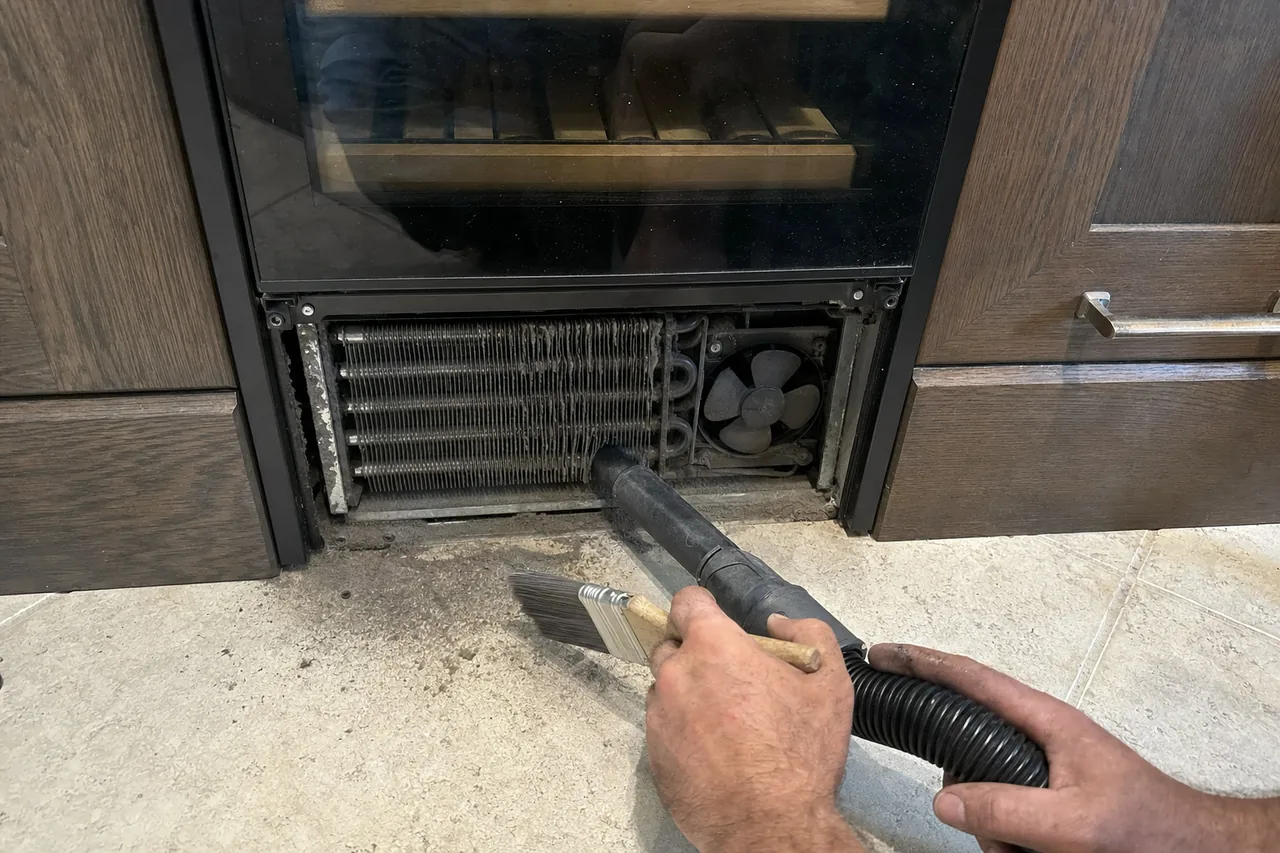
On a refrigeration call that shows up as a condenser fin pack matted into felt. The column runs long and warm, the compressor gets hot, and the reasonable assumption is a loss of refrigerant. Usually it is a loss of air. On a ventilation call it shows up at the exterior wall cap, where a gravity damper corrodes at the pivot and stops opening fully, so extraction weakens without the blower sounding any different from inside the kitchen. It reaches hinge pivots on heavy refrigerator and oven doors, and a stiff hinge takes the last inch off the door’s travel and leaves a gasket resting rather than compressing — the complaint that follows is condensation on the door face, and the cause is three feet away at the hinge. It reaches terminal blocks inside remote blower housings, where green oxide on a spade terminal makes an intermittent fault with no pattern.
The ZIP is not uniform
The balance shifts across the ZIP. On the oceanfront streets of Sawgrass Country Club and in The Plantation, salt is checked on any call regardless of the appliance. West of A1A in Sawgrass Players Club, a mile or more back from the surf line, the salt problem eases considerably and the fault is usually the appliance’s own. Marsh Landing sits on the Intracoastal side, where the air is brackish and still rather than salty and windy, and the signature there is slow connector corrosion rather than matted condensers. Palm Valley, further west again, has the most varied housing stock in the ZIP and the retrofit problems that go with it.
Older openings, newer appliances
A built-in makes assumptions about the space around it. A refrigeration column needs a defined intake and a defined exhaust; a wall oven needs its stack clearances; a dishwasher needs a supply, a drain and a run of cabinetry that has not closed in around it since it went in.
Where a kitchen has been refreshed rather than rebuilt around an appliance, we find those assumptions quietly broken: a toe-kick vent buried under later flooring, a grille panel fitted flush because it looked tidier, a top exhaust path closed off by a soffit. The appliance is rejecting heat into a box and breathing it back in. No part we can fit corrects that, and saying so at the diagnostic is cheaper for everybody than saying it at the second visit.
Weight and access matter for the same reason. A column has to come forward on its rails far enough to reach its machine compartment without touching the stone beside it, and a wall oven is a two-person lift out of a stack. Where that is the difficult part of the job, it belongs in the estimate.
The plumbed appliances
JEA publishes tap water in 32082 at 346 parts per million. Anything that boils or freezes that water keeps the mineral left behind, so a steam generator, a built-in coffee system and an ice maker all do better on a descale interval set by the calendar than by the machine’s prompt. If a house has a softener, we want to know when it last regenerated and whether the kitchen is genuinely fed from it — plumbing rerouted during a remodel does not always run where the owner thinks.
The rest of the plumbed work here is mechanical. Shut-offs behind a dishwasher or a coffee system seize if they have never been turned, and supply lines run behind cabinetry closed up after installation. On a first visit we establish where the water comes from and where it can be stopped, before anything is disconnected.
Storms and outages
There are roughly sixty-eight thunderstorm days a year here, and this coast has had multi-day outages in living memory — Matthew in 2016, Irma in 2017, Helene in 2024. Appliance controls take that damage quietly. A board rarely dies outright; more often one output stops and the rest carries on, which is why owners seldom connect the fault with the weather. Inverter-driven compressors and their drive boards can fail weeks later. If something stopped the morning after a storm, or in the fortnight after the power came back, that timing changes the order we test in.
Kitchen equipment, not house equipment
Salt does not confine itself to the kitchen. It works just as hard on the air-conditioning condenser at the side of a 32082 house as on the one behind a refrigeration column’s toe-kick grille, and the two problems read almost identically in a homeowner’s description: something is running constantly and nothing is getting cold.
Only one of them is ours. Seagate repairs the built-in appliances fitted into the cabinetry — cold, cooking, steam, dishwashing, coffee and extraction. We do not repair or install heating, air conditioning, heat pumps, air handlers or duct systems anywhere in Ponte Vedra Beach, and we are not a heating and air company under another name. The hood duct running out through a wall cap is the only duct on this site, and it exists to get cooking air out of the kitchen.
It is worth the paragraph because the wrong visit costs a homeowner a day. If the complaint is the house, the number to call is an HVAC contractor’s. If the complaint is an appliance with a Thermador badge on it, it is ours.
What a visit covers
We inspect the air path and the installation on any refrigeration or ventilation call before considering a sealed system or a board. We hold EPA Section 608 certification and can open a sealed circuit when the readings justify it; in this ZIP they often do not. What the visit costs, what is guaranteed afterwards and which makes we take on are set out above, in figures.