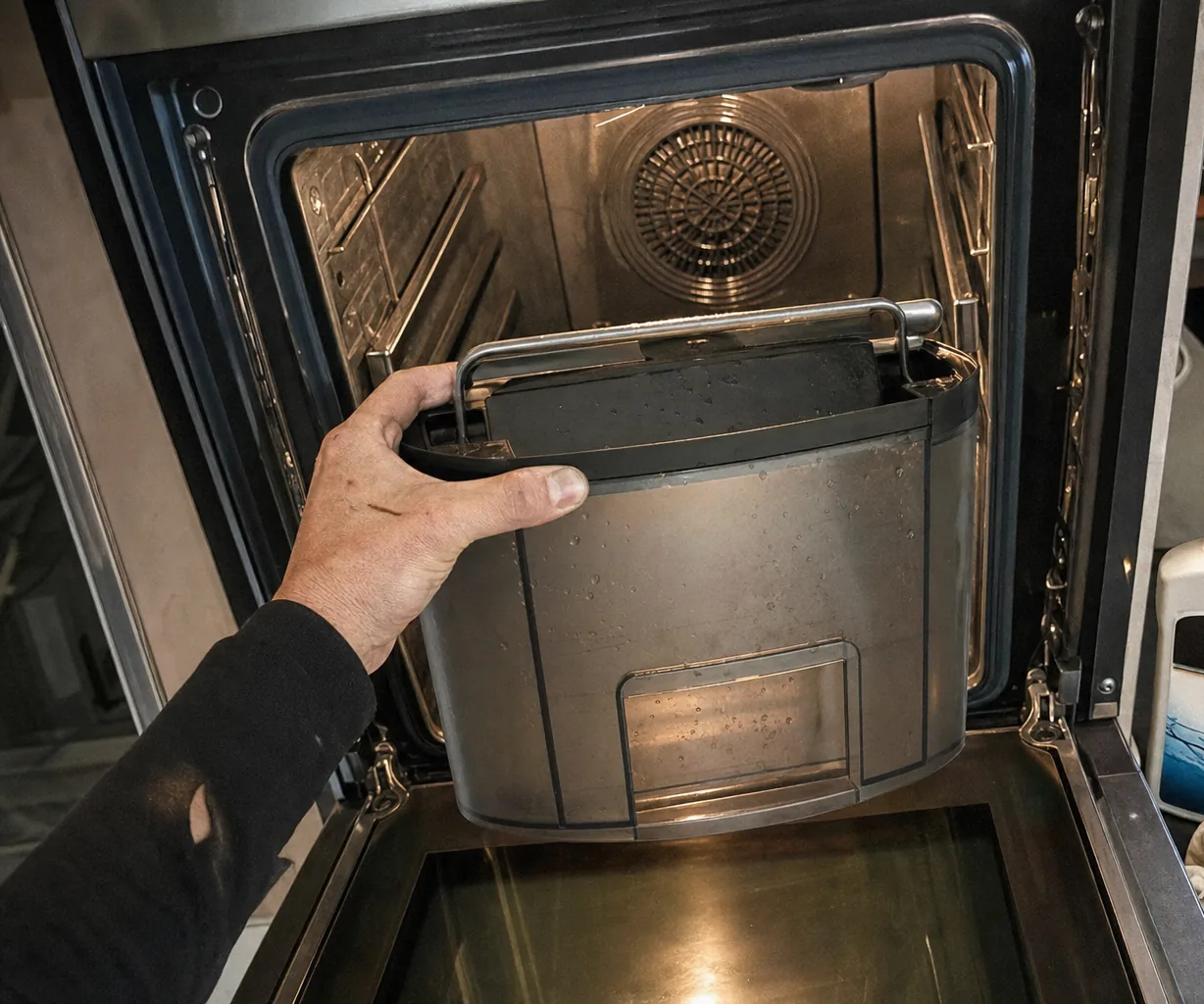
Most of a diagnosis happens in the first twenty minutes of a visit, and a good share of it is information the owner already has. What follows costs about ten minutes, needs no tools and involves opening nothing. Done before you call, it changes what goes on the van and occasionally settles the question without a visit at all.
1. Photograph the rating plate
This is the one that matters most. Every built-in carries a plate with the model and the serial number, usually inside the door, behind the toe-kick, or on the side of the cavity where the door swings clear.
The model narrows the part. The serial settles it. These appliances run for years across production changes, and two that look identical from the front can take different boards, valves, hinges or seals depending on when they were made. With a photograph we check availability before the van is loaded, which is often the difference between one visit and two — and if a part turns out to be on a long lead time or no longer made, you hear that at the diagnostic rather than a fortnight later.
2. Establish when it last worked properly
Not when the fault became annoying: when it was last unambiguously right. Faults that developed over a year are different faults from ones that appeared overnight, and the two get tested in a different order.
Anything sudden is worth dating against the weather and the power. This coast gets around sixty-eight thunderstorm days a year and has had multi-day outages in living memory, and appliance controls take that damage quietly — a board that survives a surge often comes back with a single output dead, so the oven heats and the fan does not. Damage can also surface late: an inverter-driven compressor and its drive board can fail weeks after the event that hurt them. “It started the morning after the storm” is a diagnostic statement, not small talk.
3. Measure what the appliance actually does
Symptoms described in adjectives are hard to act on. Symptoms described in numbers are not.
For an oven, put a thermometer on the centre rack, run it from cold with nothing in it, and record what it reaches at two different setpoints. For a dishwasher, time a full cycle from a cold start on an empty machine, on the same programme, twice. For a refrigerator, put a thermometer in a glass of water in the middle of the cavity overnight rather than reading the door display, and note whether the column beside it is holding.
Each of those takes an hour of waiting and no attention, and each of them frequently decides the diagnosis before we have the door off.
4. Check the door, with a strip of paper
Close a strip of paper in the door at four points along its length and pull each one out. Even resistance at all four means the seal is doing its job. Slack at one corner means the hinge rather than the gasket, and a hinge that has lost travel will keep destroying gaskets until it is dealt with.
This applies to more appliances than owners expect: ovens, steam ovens, dishwashers and refrigerator columns all depend on a gasket being compressed rather than merely present. A surprising number of “it does not hold temperature” calls end at a door.
5. Look at the air path
On anything with a condenser, find the intake and the exhaust and confirm they are open. On a column that usually means a toe-kick grille at the bottom and a clear path at the top. Flooring laid over a toe-kick vent during a later refresh, a grille panel fitted flush because it looked tidier, a soffit added over the top exhaust — all of them turn a working appliance into one that rejects its heat into a box and breathes it back in.
If you can see the fin pack, look at it with a light behind it as well as in front. Within sight of the Atlantic a fin pack matted with salt-damp dust looks clean from one side and is solid from the other.
6. Find the shut-offs and the breaker
Before anything is disconnected, somebody has to know where the water stops and where the power stops. For a dishwasher, a coffee system or a plumbed appliance that means a shut-off that may not have been turned since the day it was installed. For the whole kitchen it means knowing which breaker serves what, which is rarely what the panel label says.
Finding that out during a repair rather than before one costs an hour, and it is an hour you are paying for. It also matters on a suite: built-ins expect dedicated circuits at their specified rating, and a fault that only appears when two appliances run together is a circuit story rather than an appliance story.
What none of this replaces
Observation, not intervention. Nothing above involves removing a panel, opening a sealed circuit or working on anything electrical, and none of it should. The point is that the half of a diagnosis which depends on knowing the house is the half you are better placed to do than we are — and when you have done it, the visit starts where you finished.
Flat $80 diagnostic, credited in full toward the repair. Written estimate before any part is ordered.