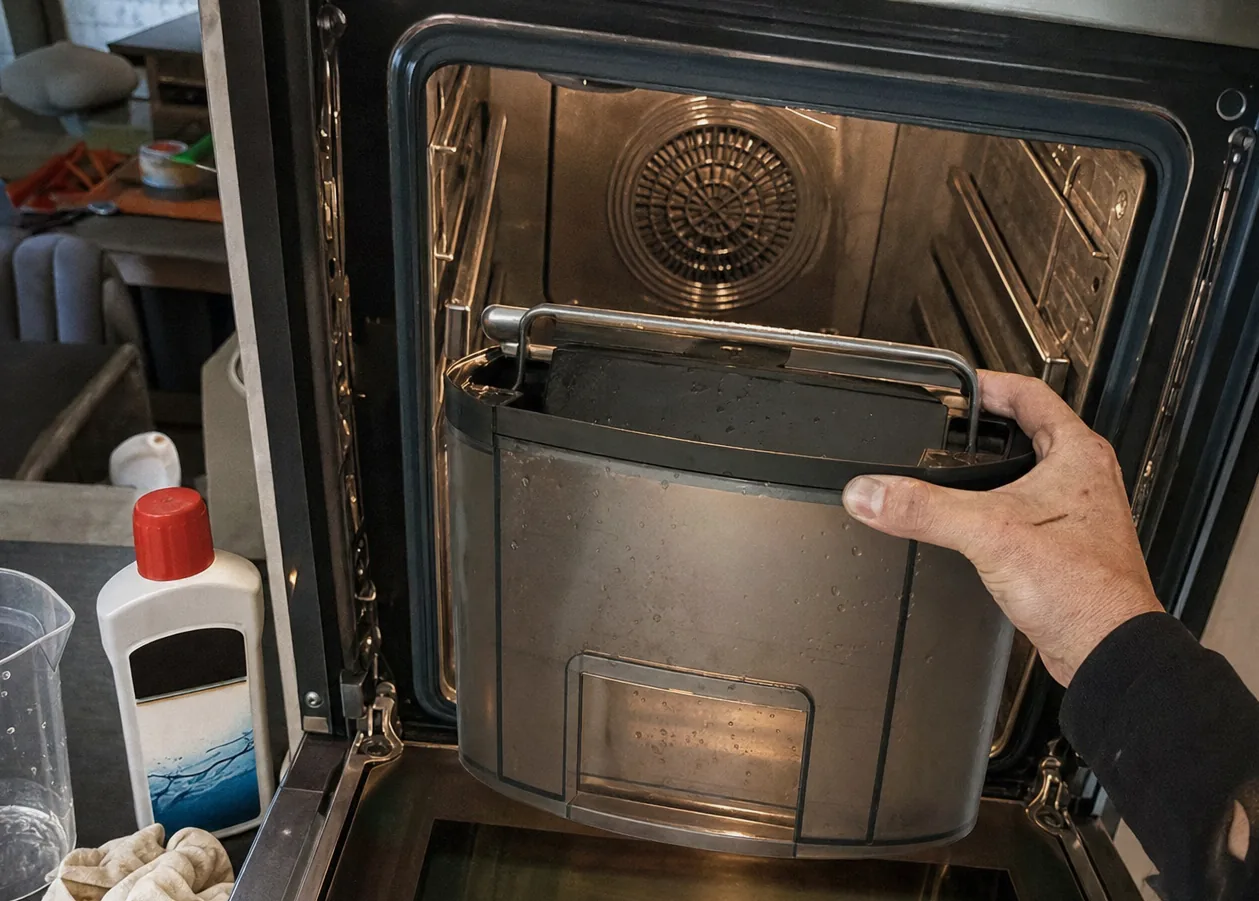
A steam oven is a small boiler with an oven wrapped around it. That is the whole reason it behaves differently from every other cooking appliance in the kitchen: it has a water circuit, a pressure boundary and a sealed door, and each of those is a thing that can fail on its own.
The generator, and how it reports itself
The generator holds water, heats it, and tells the control how much is in there. Two of those three are wear items and the third is a sensor.
The element is the part that decides how quickly the cavity fills. An oven that used to reach steam in a couple of minutes and now takes four or five is delivering less of its heat into the water and more of it into whatever has accumulated around the element. Nothing is broken at that stage; what has changed is the rate.
The level sensor is the part that decides what the control believes. When it reports fiction — a full reservoir read as empty, or an empty generator read as full — the machine either refuses to start or runs a heater against nothing. That is the point at which most owners call, and it is worth calling then rather than later: an element that has spent months running under an insulating layer or against a dry chamber blisters, and a blistered element in a sealed water circuit is a leak waiting for a weekend.
We open the generator rather than guess at it. If the element and the sensor can be cleared and the seals are sound, they are cleared. If they cannot, that gets said at the diagnostic and priced, rather than charged for as an afternoon that will not hold.
The order the symptoms arrive in
A steam oven degrades in a sequence, and knowing where you are in it tells you how much of the appliance is still recoverable.
Time to steam goes first, and it goes slowly enough that nobody notices the day it changed. Temperature stability goes second: combination cycles that mix steam with convection become inconsistent, because the two heat sources are no longer arriving in the proportion the control assumes. Bread and custards notice this before people do, which is why a baker in the house is often the one who reports the fault.
Sensing goes third, and mechanical failure goes last. Reaching us at stage two or three usually means a component. Reaching us at stage four usually means several.
Doors, gaskets and the cabinet above
The door is the second job and it is the one with collateral damage attached. The gasket on a steam oven has to seal against heat and moisture at once, and daily thermal cycling hardens it from the hinge side outward. A door that fogs the cabinet above it is not a door that needs adjusting — it is a gasket that has stopped compressing.
The check an owner can do is a strip of paper closed in the door at four points along its length. Even resistance at all four means the seal is doing its job. Slack at one corner means the hinge, not the gasket, and a hinge that has lost travel will keep destroying gaskets until it is dealt with.
Left long enough, escaping steam swells the cabinet face above the appliance and lifts the finish. That damage is not repaired by fixing the oven, which is the argument for treating fogging as urgent rather than cosmetic.
Water in and water out
Reservoir models and plumbed models fail differently at the front end. A reservoir model depends on a seating seal and a float or probe that is handled every time it is filled; a plumbed model depends on a fill valve, a shut-off somewhere behind the cabinetry, and a supply line that was routed during the installation and has not been looked at since.
Both depend on getting the water out again. The cavity drains, and a drain that has partially closed leaves standing water on the cavity floor, which is what produces the faintly sour smell after a bake. That is a cleaning job far more often than it is a component, and it is one we would rather show you than charge you for twice.
Access and clearance
A steam oven is usually stacked with a wall oven or set in a tall run, which makes it a two-person lift out of its opening. It needs its cavity clear, its door off or fully open, and enough floor in front to set it down. Where a kitchen has been refreshed around the appliance — flooring built up under the opening, stone returned tight to the trim — getting it out is a real part of the job, and it belongs in the estimate rather than in a surprise.
Photograph the rating plate before you call. Generators, sensors and door seals change across production runs, and the serial number is what lets us check the part before the van is loaded.
Terms
Flat $80 diagnostic, credited in full toward the repair when you approve the work. Written estimate before any part is ordered or any labor is billed. Genuine OEM parts, 90 days on labor and 365 days on parts. We work Mon–Fri 8 to 6 and Sat 9 to 4, on Thermador built-ins and nothing else, which is why the parts on the van tend to be the ones your oven needs.