The Plantation sits at the southern end of Ponte Vedra Beach, off A1A near Mickler Road, on large low-density lots under a mature live oak and pine canopy. It is close enough to the Atlantic to get the salt, and wooded enough to get something the more open parts of 32082 do not.
What the canopy contributes
Salt aerosol makes a condenser fin pack tacky. It is hygroscopic, so it holds atmospheric moisture against the aluminium, and a damp fin will hold whatever lands on it.
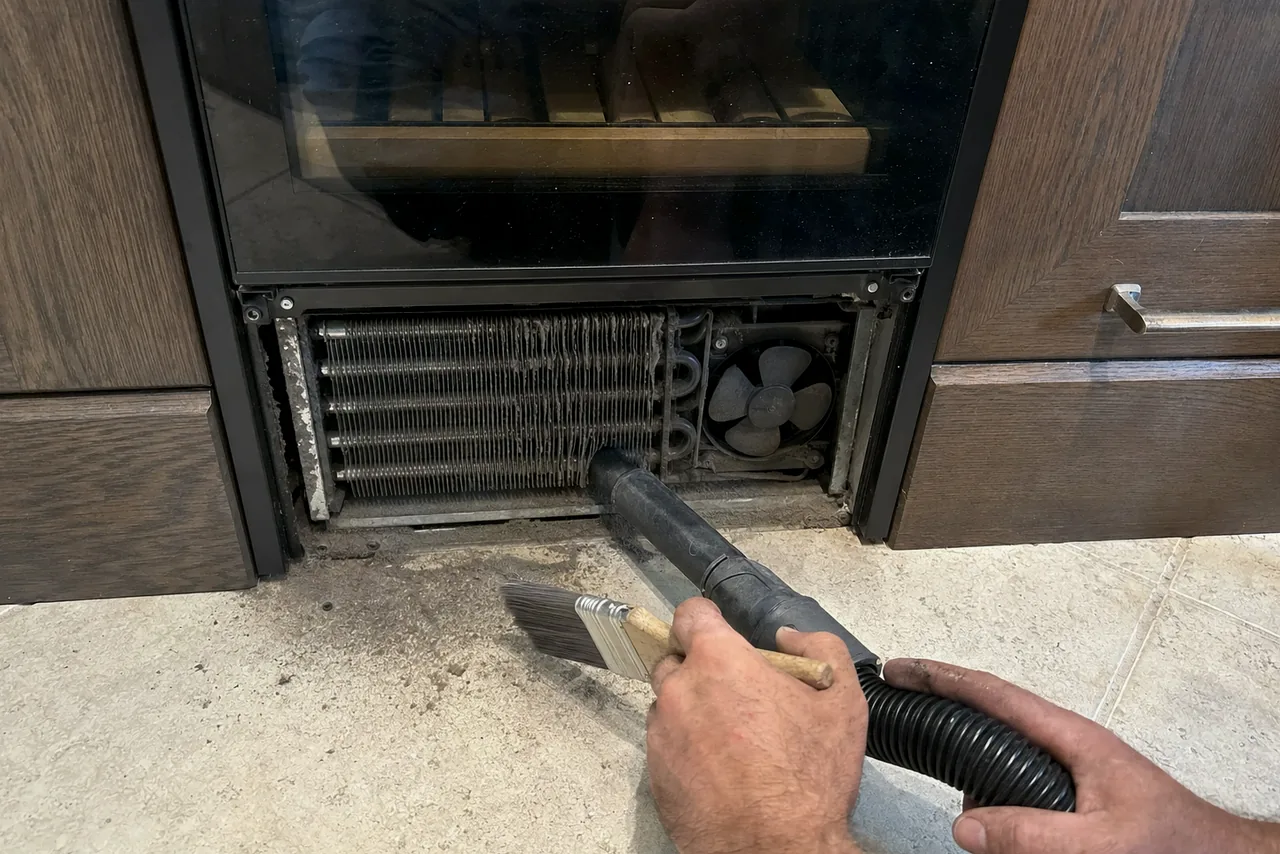
Under a heavy oak canopy, a great deal lands on it. Live oaks shed catkins and leaf litter in spring rather than autumn, and the shed is dense and fine — small enough to pass an intake grille and reach the fins behind it. Pine adds needles and, in the spring, the pollen load that coats every horizontal surface in this part of St. Johns County for several weeks. Individually none of that would close a condenser. Landing on a salt-damp fin pack, it mats.
The result is a refrigerator column that runs long and warm with a fin pack that looks clean from the front and is solid from the back. We check condensers here with a light behind them, from both sides, because the front view is misleading.
The same debris reaches hood intakes and exterior wall caps. A gravity damper already stiffening from salt at the pivot will hold half open once organic material has packed the hinge, and the blower then works against a restriction nobody can see from inside the kitchen.
What the canopy costs a condenser fan
The debris load has a second consequence that owners rarely connect with the first. A condenser fan running against a partially blocked fin pack works harder for less air, and the fan motor and its bearing are the parts that record that. A fan that has spent two summers pulling through matted aluminium is noisier than it was, and the noise arrives long before the temperature complaint does.
That gives an owner here a genuinely useful early warning. If the refrigerator has developed a hum or a whirr it did not have last year and the temperatures are still fine, the fin pack is worth looking at now rather than in August. A clean is a short job. A fan motor and a warm column together is not.
We check condensers here with a light behind them, from both sides, and we check the fan by hand for end-float and drag rather than by ear alone. Where the fin pack has been left long enough to have corroded as well as clogged — salt and damp organic litter together will do that to aluminium — cleaning recovers less than it looks like it should, and it is fairer to say so than to charge for the afternoon.
Large kitchens, long duct runs
Low-density houses tend toward larger kitchens, and larger kitchens put the cooktop further from an exterior wall. Long horizontal duct runs with several elbows lose airflow to friction on the day they are installed and lose more each year as grease condenses inside them. An owner who has cleaned the filters and still cannot clear steam from a rangetop is usually looking at the wrong end of the system.
Where a remote blower has been mounted in an attic here, it is working in an unconditioned space in coastal humidity, and the terminal block inside its junction box is worth inspecting before the motor is condemned.
Which condenser we mean
There are usually two condensers on a Plantation lot, and the canopy is hard on both. One sits on a pad at the side of the house and belongs to the air conditioning. The other is inside the kitchen, behind the toe-kick grille of a refrigeration column, and that is the one we came for. When these pages talk about a fin pack matted with oak litter and pollen, they mean the appliance’s own, reached through its front panel with the column rolled forward on its rails.
The unit on the pad is not our work. Air conditioning, heat pumps, furnaces, air handlers and the ducts running through these attics belong to an HVAC contractor, and nobody at Seagate installs or services any of it. The distinction matters more here than in most neighbourhoods, because a resident under this canopy may well need both trades in the same spring — the outdoor unit cleared of leaf litter by one company, and a warm refrigerator column looked at by us.
What a first visit covers
We inspect the condenser and the intake and exhaust path on any refrigeration call before considering the sealed system. We hold EPA Section 608 certification and can open a sealed circuit when the readings justify it — under this canopy, they rarely do.
Mon–Fri 8 to 6, Sat 9 to 4. Flat $80 diagnostic, credited in full toward the repair when you approve it. Written estimate before any part is ordered, genuine OEM parts, 90 days on labor and 365 days on parts. Thermador built-ins only.