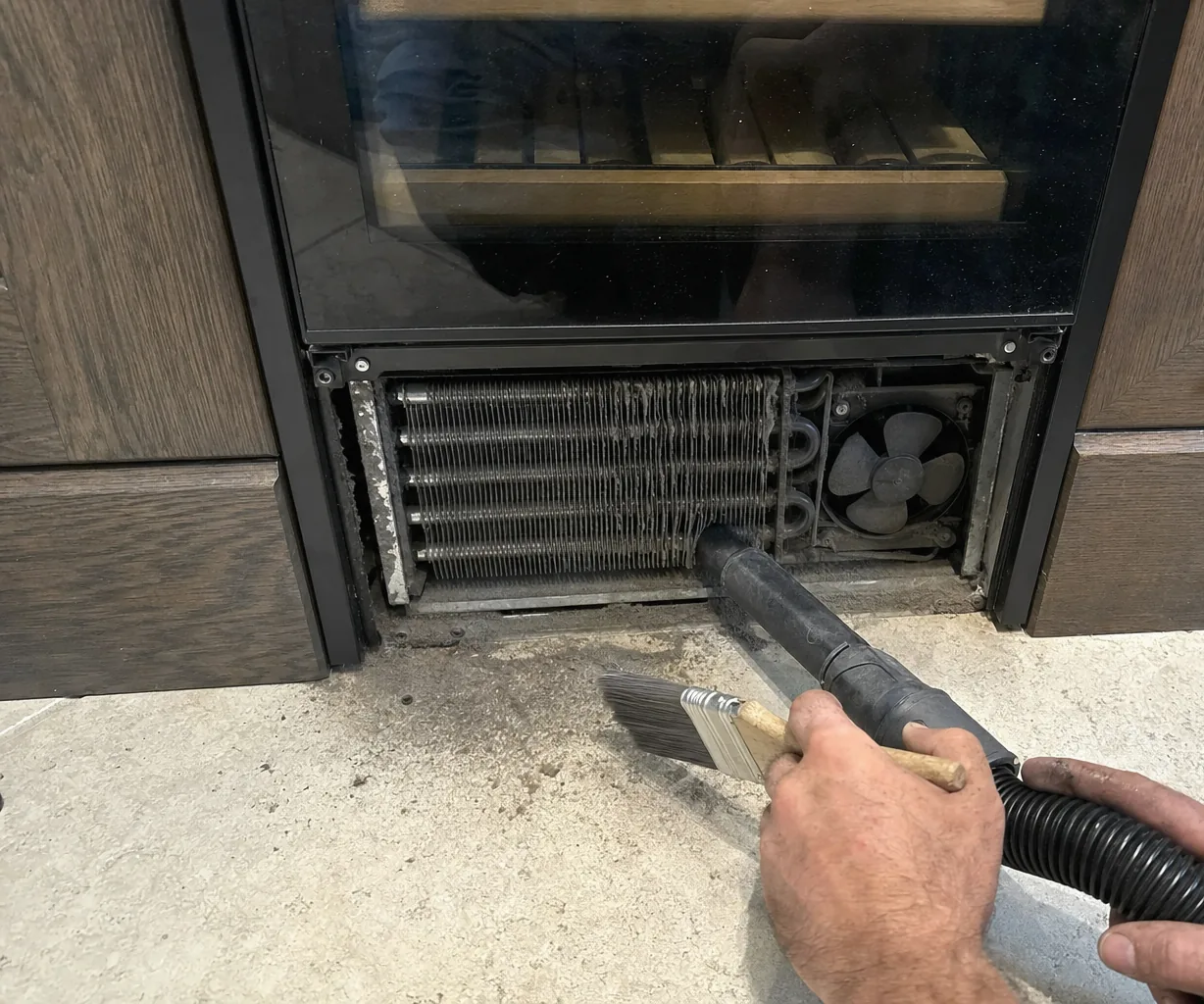
A built-in refrigerator that holds ten degrees warm, runs almost continuously and has a compressor too hot to keep a hand on is describing a condenser problem. Within a mile of the Atlantic that is what it usually is.
Why the coast is different
Onshore wind carries salt aerosol inland every day. It lands on the condenser, and because salt is hygroscopic it does not simply sit there — it holds atmospheric moisture against the aluminium fin. The fin pack accumulates a damp film that binds ordinary household dust and pet hair into a mat, and the mat does exactly what a mat does: it stops air moving through the gaps the fins exist to create.
Corrosion follows. Aluminium fins bonded to copper tube in a salt-wet environment corrode preferentially, and once the fin loses contact with the tube it stops conducting heat regardless of how clean it looks.
Why it presents as a refrigerant fault
The symptoms line up almost perfectly with a low charge, which is why so many of these get diagnosed wrongly.
A blanketed condenser cannot reject heat, so condensing temperature climbs. Head pressure climbs with it, the compressor works harder against it, and the evaporator receives less usable cooling per cycle. The compartment settles several degrees warm and stays there. The compressor runs almost continuously and gets hot enough that an owner touching it concludes something serious is happening.
All of that is true of a system short of refrigerant as well. The difference is that a system short of refrigerant has a leak, and a leak has a location. If nobody has found one, and the appliance sits within a mile of the water, the condenser is the more probable explanation and it is free to inspect.
There is a second tell. On a two-column installation, a warm refrigerator beside a freezer that is holding perfectly means two independent sealed systems, one of which is fine. That does not disprove a refrigerant fault, but it makes an environmental cause — shared cabinet, shared airflow, shared salt exposure — considerably more likely than two simultaneous internal failures.
What we check first
The condenser fan first: whether it runs, whether it runs at the right speed, and whether the grille in front of it has been blocked by cabinetry that was fitted after the appliance. Then the fin pack itself, from both sides, with a light behind it — a condenser can look presentable from the front and be solid from the back.
Then the airflow path. Built-ins in this area are often installed in tall cabinet runs with the toe-kick vent covered by flooring added later, or with a return path that was closed off during a kitchen refresh. The appliance is rejecting heat into a box.
Only after all of that does a sealed-system diagnosis make sense. We hold EPA Section 608 certification and can open a sealed circuit when the readings justify it — but on the coast the readings usually do not, and a system opened unnecessarily is a system that will never be quite as good again.
What an owner can do
Twice a year, pull the grille and look at the condenser with a torch. If you cannot see light through the fin pack, it needs cleaning. Near the water, twice a year is a minimum rather than a schedule.