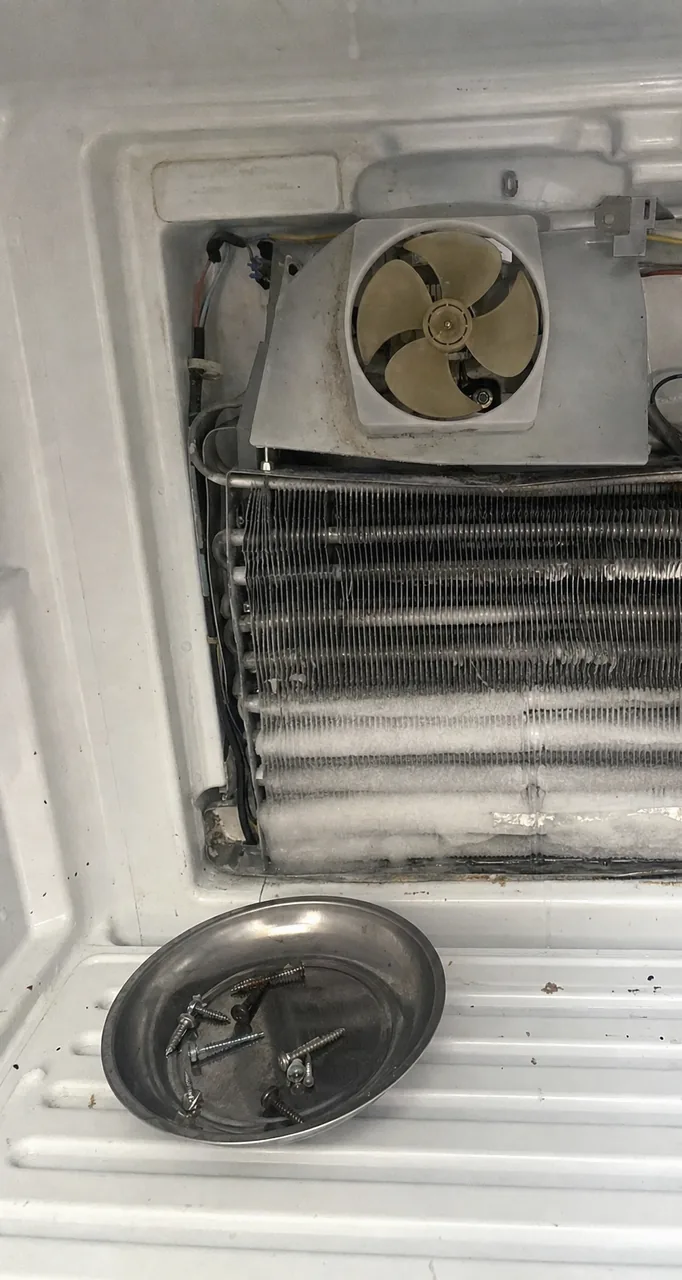
Thermador builds refrigeration as columns — separate refrigerator, freezer and wine cabinets, each with its own sealed system, installed flush into a cabinet run. That architecture is why they hold temperature so evenly, and it is also why they are unforgiving about installation. A column rejects its heat through a condenser at the base or the top, into whatever air the cabinetry gives it. Take that air away and nothing else about the appliance matters.
The warm column that is not a refrigerant problem
The call we get most often in 32082 is a refrigerator column sitting eight or ten degrees above setpoint while the freezer column next to it holds perfectly. Two independent systems, one failing: that alone rules out most of the theories an owner has already worked through.
Within a mile of the Atlantic the cause is usually the condenser. Onshore wind carries salt aerosol inland every day of the year. Salt is hygroscopic, so it does not simply settle on the aluminium fins — it holds atmospheric moisture against them, and that damp film binds ordinary dust and pet hair into a felt. The fin pack stops being a heat exchanger and becomes insulation. The compressor responds by running longer, which raises the head pressure, which makes the condenser even less able to shed heat.
The second cause is the cabinet itself. Columns need a clear intake and a clear exhaust, and in a kitchen that has been refreshed since the appliance went in, one of the two has often been closed off — a toe-kick vent buried under new flooring, a grille panel fitted flush because it looked better, a top exhaust path blocked by a soffit added during a remodel. The appliance is rejecting heat into a sealed box and then re-breathing it.
Only when the fan, the fin pack and the airflow path have all been cleared does a sealed-system diagnosis make sense. We hold EPA Section 608 certification and can open a sealed circuit when the pressures and the superheat justify it. On this stretch of coast they usually do not.
Ice makers, read from the cubes
The other half of our refrigeration work is ice, and the useful thing about an ice maker is that it publishes its own condition several times a day. The cubes in the bin describe the fill and freeze cycle that produced them.
Hollow cubes with a thin wall and a cloudy centre point at the fill. The fill quantity on these machines is set by time rather than by volume — the valve opens for a fixed period and the mould receives whatever arrives in it — so anything that reduces flow reduces the cube. An underfilled mould also freezes faster, which traps dissolved air instead of pushing it ahead of the freeze front, and that is what turns the centre opaque.
Cubes that will not release point at the mould surface rather than the fill. The harvest heater has to work longer to free them, and a harvest arm that meets a cube still bonded to the mould stalls. Repeated stalls are hard on the harvest motor, which is why a machine left in this condition tends to fail mechanically rather than gradually.
Fused slabs and a sheet of ice under the bin mean the fill is arriving late, partially, or over the outside of the mould. Water that misses the mould runs down and freezes below, and owners describe that as the freezer leaking.
Two things get blamed here and are usually innocent. The refrigerator’s water filter is a taste and particulate filter and changing it will not alter any of the above. And the freezer temperature is not the problem if the column beside it is holding perfectly — that is a water-path fault in an appliance whose refrigeration is working.
Defrost, doors and drains
Frost on a gasket and water under a crisper are usually the same fault seen from two ends. The defrost cycle melts frost off the evaporator, the meltwater runs to a drain, and the drain runs to a pan over the compressor where it is meant to evaporate. Block the drain — with mineral deposit, with a fragment of packaging, with biofilm — and the water backs up into the cavity floor and freezes there.
Doors are their own job. A column door is heavy, and its closer is a mechanism rather than a spring. Salt reaches hinge pivots through the door gap, and a hinge that has stiffened stops the last inch of travel, which leaves a gasket resting rather than compressing. The symptom the owner reports is condensation, not a door problem.
What a visit looks like
Flat $80 diagnostic, credited in full toward the repair when you approve it. Written estimate before any part is ordered. Genuine OEM parts, 90 days on labor and 365 days on parts. If the fault turns out to be a blocked vent or a condenser nobody has reached in six years, we will tell you that and show you where it is.