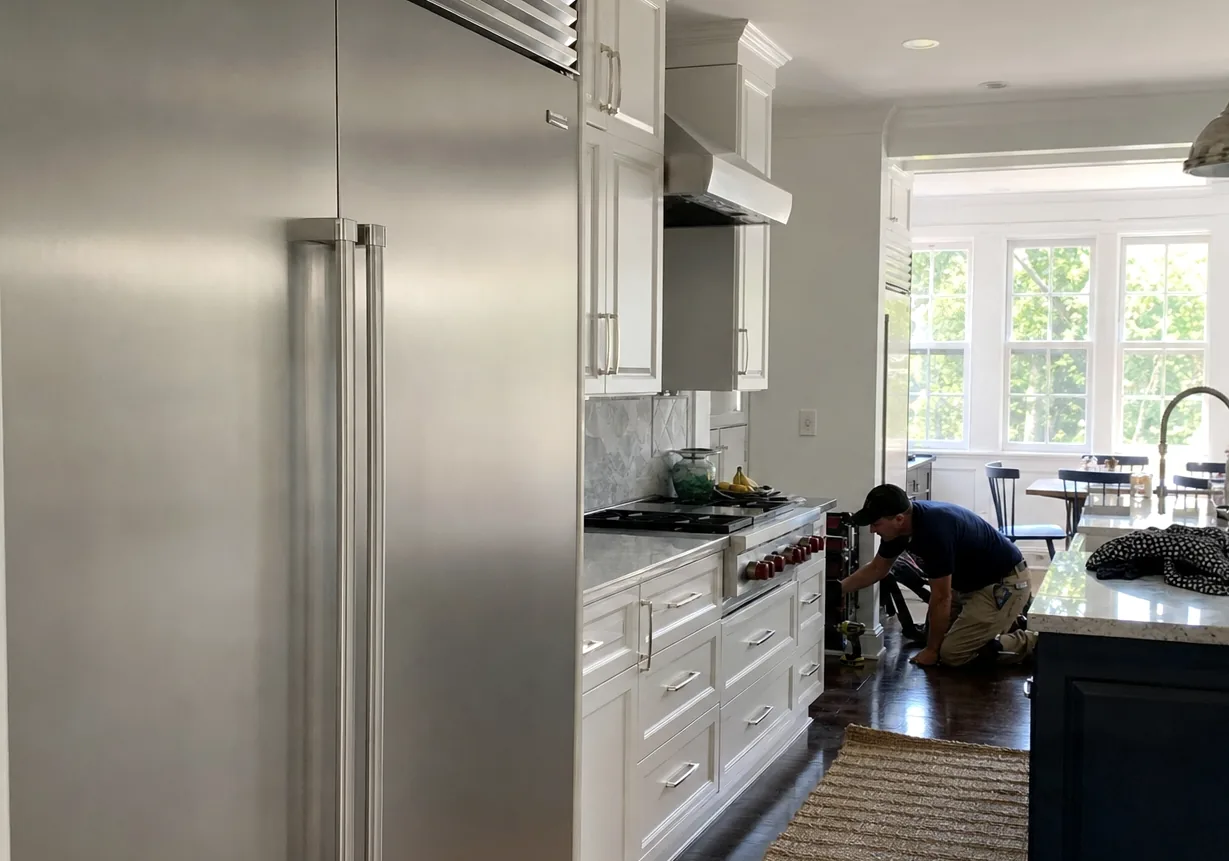
Marsh Landing sits on the west side of A1A, backing onto the Intracoastal Waterway and the salt marsh that runs along it. It shares the ZIP and the general coastal exposure of the rest of Ponte Vedra Beach, but the air here behaves differently enough from the oceanfront that the failure pattern shifts with it.
Brackish and still, rather than salty and windy
On the ocean side, salt arrives on a steady onshore breeze that also dries surfaces between gusts. On the marsh side the air is brackish and it barely moves. Humidity stays high, dew points sit close to ambient overnight for much of the year, and metal surfaces spend long periods genuinely wet rather than intermittently damp.
Corrosion cares more about time-of-wetness than about salt concentration. That is why we find a particular signature on this side of A1A: less of the crusted white bloom you see on an oceanfront condenser, and more of the slow, even pitting and green oxide on connector pins, spade terminals and the earthing points inside appliance junction boxes. It produces intermittent electrical faults with no pattern an owner can describe — a hood that works all week and fails on Sunday, an induction zone that drops out only sometimes, a control that comes back to life after a technician has driven away.
A new board plugged into a corroded harness has a short life, and on this side of the neighbourhood we check the harness before we quote the board.
Garages and second refrigeration
A lot of homes here were built with a second refrigerator or a freezer column in the garage, and on the marsh a garage is a humid outdoor space with a door on it. Refrigeration installed there runs against a higher ambient temperature and a much higher moisture load than the same appliance would in a conditioned kitchen.
The consequences are predictable: longer run times, heavier frost accumulation on the evaporator, a defrost cycle that has more to remove than it was designed for, and a drain that eventually cannot keep up. Water backs into the cavity floor and freezes into a sheet. Owners read that as a defrost fault. It often is, but the reason it happened is the room.
Wine columns in garages have the same problem from the other direction — they hold a narrow temperature band and have to fight ambient to do it.
Installations reaching the end of a first cycle
The bulk of Marsh Landing was built through the late 1980s, the 1990s and the 2000s, which puts a large share of its original built-in kitchens somewhere past twenty years old. Second and third owners are now replacing first-generation appliances into cabinet openings that were sized for them.
That is generally good news — openings from this era are close to current standards, so a column usually fits. What does not always fit is the airflow. We regularly find toe-kick vents blocked by flooring added in a later refresh, and exhaust paths closed off during a remodel that nobody connected with the refrigerator running warm two years later. Marsh humidity makes that worse, because the air the appliance is re-breathing is already carrying moisture.
Parts, and why we ask for the serial
A neighbourhood of twenty- and thirty-year-old kitchens is a neighbourhood of long production runs. Two Thermador built-ins that look identical from the front can take different boards, valves, hinges or seals depending on when they were made, because a manufacturer revises a component without renaming the appliance. The model number narrows it; the serial number settles it.
That is why the first thing we ask for on the phone is a photograph of the rating plate inside the door or behind the toe-kick. With the serial we check availability before the van is loaded, which is often the difference between one visit and two. It also lets us tell you at the diagnostic — not afterwards — when a part is on a long lead time or is no longer made, and what the realistic alternative is. On an appliance of this age that conversation is part of the job, and it is the point at which the repair-versus-replace arithmetic on a built-in is worth doing out loud: the labour to get back into a fitted opening is much the same whichever decision you make, so it is worth making once.
Getting to you
Marsh Landing is gated and the internal road network is long, so put the visit on the resident list before the technician arrives. From our side of A1A the drive is short; the gate is what costs time.
Mon–Fri 8 to 6, Sat 9 to 4. Flat $80 diagnostic, credited in full toward the repair. Written estimate before any part is ordered, genuine OEM parts, 90 days on labor and 365 days on parts. We work on Thermador built-ins and nothing else.